
Shallow (Point) Well Installation

Well Water Connection is one of very few companies in New England that install Point Wells. Our unique approach differs from others who use large, disruptive equipment and less precise methods to install shallow wells. Contact us today for a Free Virtual Site Review and find out if a point well is right for you!

What is a shallow (point) well?

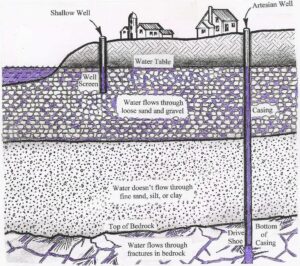
A point well is the simplest and most cost-effective type of shallow well you can install. Shallow wells draw groundwater from sand or gravel layers beneath properties with high water tables. They are commonly installed for irrigation and outdoor watering, and in many cases may still serve as a whole-house water source.

Shallow wells and point wells are not possible for every property, but when conditions are favorable, they provide excellent value and a dependable source of fresh, clean water… with little-to-no disturbance to landscaped properties.

Key Advantages of our Point Well Installations:

  • Very cost-effective (costing thousands less than other types of shallow wells and deep bedrock wells)
  • Installed using lightweight, portable equipment, with virtually no property disturbance. Usually no need to remove fence panels, trees or other obstructions 
  • Can be installed where trucks and trailers cannot access (within 18” of foundation walls and fences; in pool areas; at the bottom of steep slopes; in thickly wooded areas, inside greenhouses; inside barns; in the basement of homes; etc.)
  • Minerals like iron (which cause rust stains) are checked for during the test-hole process instead of after the well is installed. This helps to avoid rust staining
  • We are able to pinpoint the “sweet spot” on the property… where we optimize water quantity & quality… before completing the well & pump installation
  • With proper treatment and testing, point wells are still a dependable, domestic (whole-house) water source option for many homes
  • Point wells can deliver equal (or better) water flow, water pressure and water quality when  compared to deep bedrock wells 
  • Point wells have a much faster installation time
Our Process

Free Virtual Site Reviews - Why is this important?

Point wells and bedrock wells differ significantly in site preparations, equipment needed, timelines, local regulations and installation costs. Because of their many benefits, we often recommend a point well if site conditions (water table and soil conditions) appear favorable and one will meet your needs. So, determining whether a point well is possible on your property is the critical first step.

Our Virtual Site Review & Sales Process

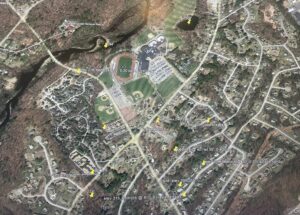
First, we review any satellite imagery of your property and the surrounding area. Then we investigate and log existing wells that are in the area using a water well database finally, we overlay the above data with other available information to estimate (from the ground surface of your property):

-Depth-to-water
-
Depth-to-bedrock
-Soil types and conditions

After reviewing the above information and your town’s regulations including any permitting requirement such a setback from septic systems, property lines, etc., we will provide you with a formal, written estimate for a shallow point well test hole, which, if successful, can be converted into a fully operational point well & pump system. With your estimate approval, we will come out to your property to flag-out one or more proposed well location(s), with the actual number of test holes to be determined later, based on the results of prior test hole(s). Afterwards, we contact dig-safe for clearance and schedule the work.
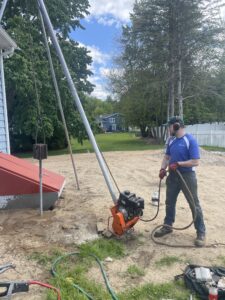
Before the installation of a successful point well is possible, one or more test holes are needed. A shallow well is usually possible if:

-The water table is within 20 feet of the top of the well and
-Productive layers of coarse sand or gravel are present

Shallow wells may not be viable if:

-Water is too deep
-Soil consists of too much clay or fine, silty sand preventing the flow of water into the well screen
-Soil is too dense or the presence of boulders or bedrock prevent driving the well point

Test holes are installed in the most suitable locations based on accessibility to electrical power, aesthetics, town regulations, and other site conditions.

Our test hole program includes:

-Mobilization and setup of equipment and up to 3 or more attempts (test holes) to install a point well on your property 
-Installation of galvanized pipe, couplings, and 1-3 foot stainless steel well point up to 40 feet deep
-Water quantity testing (flow rate measured in GPM) at multiple depths
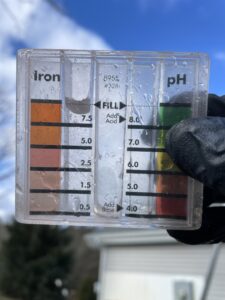
-Water quality testing (iron levels measured in PPM) at multiple depths to avoid rust staining
-Re-setting the well screen to the optimal “sweet spot” as needed
-Temporary pumping system to properly develop the test hole

If a test hole is NOT successful, materials are usually removed and discarded or relocated (if possible) to another test hole location.
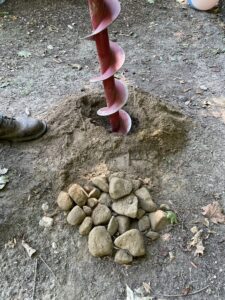
A test hole is considered successful when water quantity and quality results enable us to design a well & pump system that meets your needs.

Permitting requirements vary by town. Some municipalities require no permits for shallow wells. In those towns, we follow state guidelines.  

When a well permit is required, your town may require: 

-Certified plot plans 
-Strict setbacks (septic systems, property lines, etc.)
-Water quality testing
-Post-installation inspections

Our team coordinates directly with the local health department to streamline the permitting process. Customers are responsible for providing required site plans if needed to ensure the final well location is compliant.
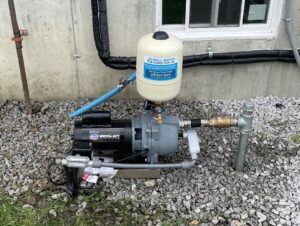
If a test hole is successful, permanent materials including a stainless steel well screen, piping, and fittings, are installed and developed into a finished well.

Because every property is unique and needs differ, we:

-Provide custom-designed well(s) & pump system(s) to satisfy your needs
-Coordinate with your irrigation company, electrician, landscaper, and other contractors involved in the project
-Offer turn-key installations through our trusted Partners-In-Service if needed
-Custom tailored annual maintenance programs for your system

Final cost is based on test-hole results and system requirements. Optional items may include:

-Larger or additional wells to increase flow 
-Pump upgrades for higher pressure needs
-Pump protection devices
-Faux (fake) rock covers
-Sediment filters
-Trenching and electrical work

Final system design cannot be confirmed until a successful test hole is achieved.

From start to finish (after DigSafe has been notified) a shallow point well can be completed in as little as 1 day. Some shallow point well installations may take several days, weeks or months, depending on town requirements, permitting, and system specifications. 

Spring Startup Maintenance 

Includes a full pump system evaluation & documentation including some or all of the following: reconnecting, repriming, inspecting, cleaning, testing, repairing or replacement of any components as needed, flushing the well, tuning up the pump system. 

Click here to learn more about our Spring Startup Maintenance >>

Mid-Summer Checkup 

Highly recommended if spring startup was not completed. Includes a full pump system evaluation & documentation including some or all of the following: inspecting, cleaning, testing, repairing or replacement of any components as needed. Tuning-up the pump system if needed based on changes in water levels and electrical demands which are common in summer months as air conditioners and pool pumps compete for limited power. Addresses performance changes caused by drought, heat, electrical demand, clogged filters, or irrigation issues.

Click here to learn more about our Mid-Summer Checkup Service >>

Fall Winterization 

Protects the pump, tank & filter system from damage caused by freezing. Includes a full pump system evaluation & documentation including some or all of the following: draining, disconnecting, inspecting, cleaning, repairing or replacement of any components as needed and/or winter storage of the pump when required.

Click here to learn more about our Fall Winterization Service >>

Periodic replacement of worn components (pressure switches, tanks, check valves, gauges) every 5–7 years is recommended. If well yield declines, redevelopment or additional wells may be installed to increase production.

Additional info for Homeowners: See our  “Caring for your Jet Pump System” resource >>

Frequently asked questions

Typically 15–30 feet, depending on water table depth and soil conditions.

The up-front test-hole program fees cover the cost of travel, labor and materials used for the testing and are non-refundable. So, there is a degree of risk associated with trying shallow well test holes. However, if testing is not successful, 50% of the test hole program cost can be credited towards a deeper artesian well & pump system

Many homes rely on shallow point wells for their only water source. In fact, the source of many communities water supplies are from shallow wells. So, with proper testing and water treatment methods, nearly all well water can be made safe to drink.

Yes, but because your well water is not treated with chlorine and other chemicals (like your town water) just filter and add pool chemicals as usual to reach the proper pH, alkalinity and chlorine levels. 

Yes. While seasonal droughts and water table changes and can impact their performance, properly installed point wells & pump systems are very dependable. This is accomplished by installing the most high-quality, stainless steel well screen in the world in the most sustainable water-bearing layer on your property and assessing it’s sustainability before moving forward to convert it to a completely new point well & pump system. 

A single residential point well & pump system can produce a sustained flow of up to 15 gallons per minute (gpm) of water or more. This amount of water will easily satisfy the average automatic irrigation system. Because water production depends on soil conditions, obviously some wells will produce less gpm. In these cases, adjustments to the irrigation heads (flow reduction) can be made to work off a single point well, or additional point wells can be installed (and manifolded together) to increase flow to and from the pump. For larger irrigations systems where demands are much higher (25+ gpm for athletic fields, residential communities, etc), multiple point wells and pumps are installed on the property to achieve the desired flow rate. 

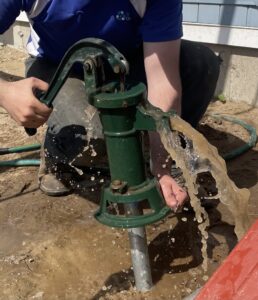
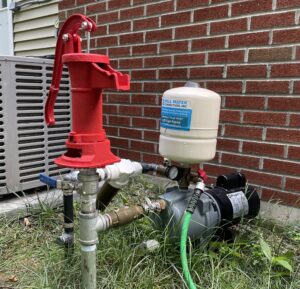
Technically, no. We install some point wells with a hand-operated, old-fashioned pitcher pump in locations where there is no power available (or where power is available), but the owner just wants the water source for their vegetable garden, for emergency back-up purposes (in the event of power loss) or just for fun! However, most of the time (to feed a home, fill a pool or to feed an automatic irrigation system), an electric pump is needed (which will need a 120v or 230v electrical source) to assure water pressure is always available.

Whenever possible, the point well and pump system is located near an existing outside electrical source (exterior outlet on home, in shed, near pool, etc).  Depending on the existing electrical source and the size (horsepower) of the pump, an electrician may be needed. In these cases, we’ll regularly coordinate with your own electrician (if you have one), recommend one to you or we can provide the electrical work (completed by a licensed electrician) ourselves.  

Well Water Connection uses 100% stainless steel screens which should last a lifetime with occasional maintenance such as cleaning and redevelopment. The galvanized pipe will corrode eventually, and need to be replaced, but typically not for at least 25 years or more depending on the corrosiveness of the soil and water around it.  

Many assume that deeper bedrock wells are better than shallow point wells. This is a misconception since each property, application and design criteria (water quality & quantity) is unique. While both are wells, shallow point wells and deep bedrock wells are no more alike than apples and oranges. Sure, both are fruit to eat, but each have their advantages and disadvantages and are produced in very different ways. Since we install, service and maintain all types of wells and pump systems, we have been able to able to successfully install shallow point well systems that delivers the same—or greater—water volume with significantly better water quality just a few feet away from an existing deep bedrock well. This service has saved customers thousands of dollars by eliminating the need for costly water treatment systems. Call us today for more details, information, and/or references!

Typically, WWC will coordinate the connection of your irrigation system to the well with your irrigation contractor or by doing it ourselves, depending on the well location and other factors. 


  • Pump System Upgrades – Increase water flow and pressure as needed for larger irrigation systems, commercial applications, larger homes, etc. 
  • Pump Overheat Protector (HIGHLY RECOMMENDED) – Provides run-dry and loss-of-prime protection by automatically shutting the pump off when high temperatures are detected, then restarting once cooled. Prevents costly pump damage and burnouts
  • Clear-View Sediment Filters (HIGHLY RECOMMENDED) – Simple, user-friendly filter to prevent sand and debris from entering and potentially damaging the irrigation system
  • Flow-Restricting Valve – Limits maximum flow rate to reduce the risk of over-pumping the well
  • Faux Rock Cover – Realistic fake rock keeps outdoor systems out of sight, protecting it from vandalism, unintended use and environmental elements
  • Variable Frequency Drive (VFD) / Smart Pump Controls – Improves efficiency, maintains consistent pressure, extends pump life, provides built in run-dry and other protection
  • Flow Meter- monitor flow rates – identify leaks or other causes of low pressure 

Low pressure Cut-Out Switch – protects against running the pump dry due to low-yield well or other issues

Yes. The pump system includes one or more outdoor faucets where you can attach a garden hose to hand water, fill your pool, wash your car, etc.  

Yes. See Annual Maintenance above.

Yes, winter is a great time to do test holes and install your point well. This is because water levels are still low from the summer months and lower than what they will likely be in the spring. This provides a great opportunity to test your property under “near-worst-case scenario” conditions. Installing your test holes in the winter also allows you to avoid the annual “springtime rush”, any price increases and possibly even take advantage of winter discounts that may be available because we are not as busy.

  • We provide a full 90-day warranty on parts & labor  
  • We honor all manufacturer’s warranties
  • We offer Annually Renewable Lifetime Warranties (ARLW) on eligible systems installed and maintained by us.

Depending on many factors, the “ballpark price” for a basic point well & pump system is about $4,000 - $8,000.

Contact us for more details and a formal estimate for your project. 

Contact Us

Types of water wells

We manage the installation of all types of wells

Whether you’re property is in need of an artesian “bedrock” well, a gravel well, or a point well. We have you covered. Learn more below.

Artesian (Bedrock) Wells

Artesian wells, also known as Bedrock wells, are generally deeper and fitted with submersible pumps and motors. With this type of well, a drilling rig is used to bore through the soil and rocks and into bedrock that exists beneath your property. Steel casing and drive-shoe are then installed into the surface of the bedrock to provide a watertight seal and prevent soil, rocks and dirty water from entering the borehole. Drilling into the bedrock resumes without casing until the borehole intersects with fractures that exist naturally in the bedrock. This factor determines how much water, if any, can be pumped.

Gravel Wells

Gravel Wells rely on water that travels through spaces in loose sands and gravels. Because they are not very deep, they may be fitted with either surface mounted or submersible pumps and motors. Installation methods include driving a well point, wash and drive methods, or by auger. With this type of well, the depth to the water table and the type of soil encountered will determine how much water, if any, can be pumped from the ground.

Shallow (Point) Wells

The Point Well is the simplest, most inexpensive type of well to install. Unlike gravel and artesian wells, which we install using very large, heavy drilling rigs, point wells can be installed using light, portable equipment we hand-carry onto your property. The use of this portable equipment enables us to install wells where larger equipment simply can't go and eliminates other added costs associated with the use of large drilling rigs. Point wells are usually 1-1/4" to 2" in diameter, less than 40' deep and are fitted with either a simple pitcher pump or electric-powered surface-mounted jet pump.

Testimonials

Hear from our happy customers

We take pride in our service and value your opinion. Read a few of the great things our customers say about us.

Well Water Connection has been great. They have always been reliable, dependable, and their work is top-notch. John has always been extremely honest in his recommendations and advice. It is clear that Well Water Connection strives to earn their clients' respect by delivering on what they promise.

Paul Schmitt Knollsbrook Condominium | Stoughton, MA

Well Water Connection is top notch! Their customer service is superb and always return phone calls and emails quickly. Jake is an excellent technician - he never leaves a mess, explains everything that is being done on the system and is amazingly courteous! You won't be disappointed with their customer service, prompt response, and expert knowledge. Since Well Water Connection started servicing our system and installed a water softener, our water quality has improved 10 fold!!!

Kristine & Kevin B. Beverly, MA

I was very happy with the results of Well Water Connection. They showed up when they were supposed to and got the job done. I had a serious iron stain problem and John took care of it like he said he would. I also had a water treatment system installed and that works well too.

Roger Calarese Calarese Properties | Franklin, MA

Join Our Email List

Sign up to receive informative emails to help manage your well water.

Well Water Connection offers water well drilling, pump & tank installations and services, water test and treatment systes, and more across Eastern Massachusetts and Southern New Hampshire.

Head Office
Copyright © 2026 All Rights Reserved | Site By Viking Creative Co.